
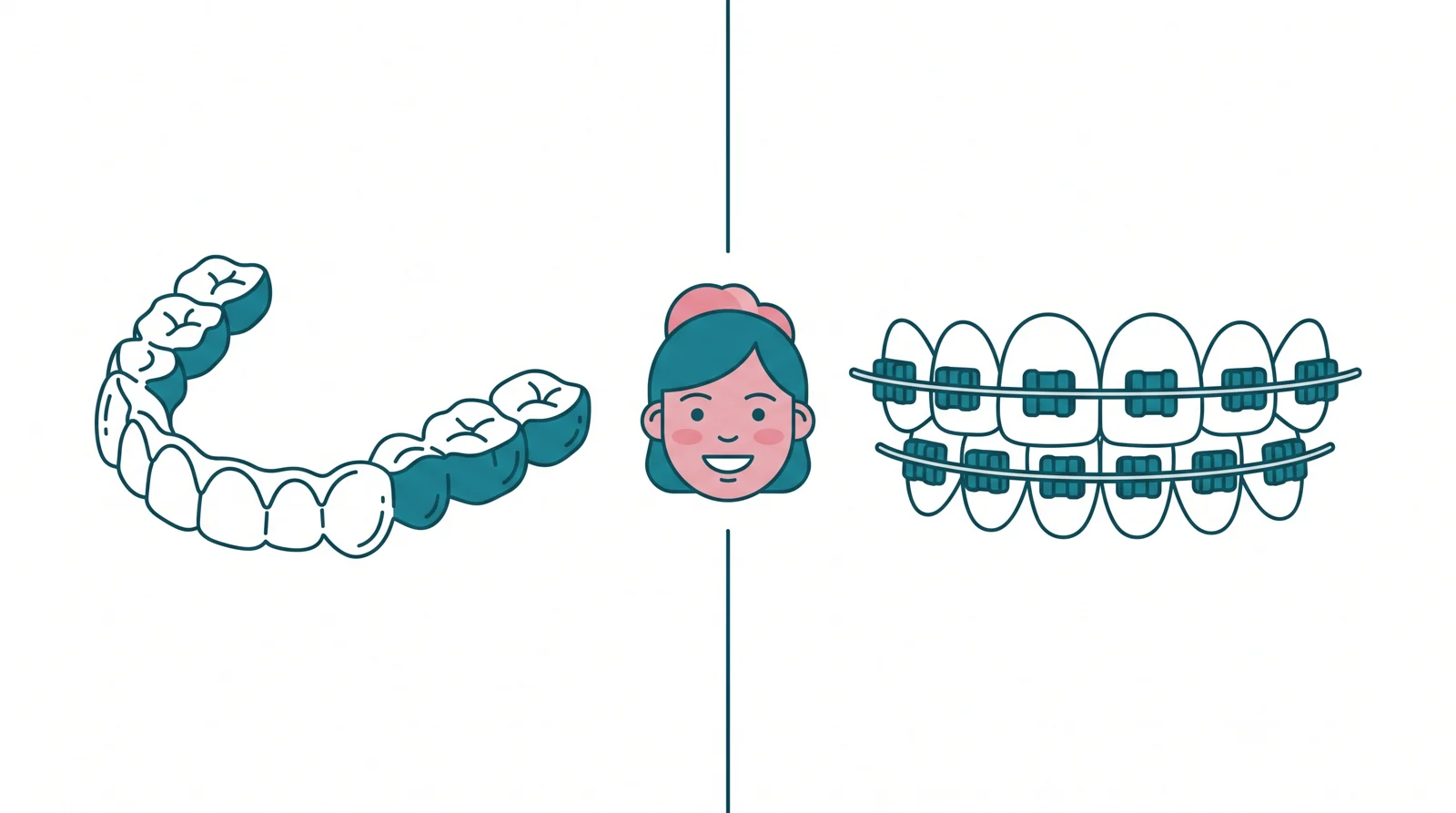
Invisalign vs braces: the quick answer
Both straighten your teeth and correct your bite — they just take different routes. Traditional braces are brackets fixed to your teeth with a wire, working around the clock with no effort from you. Invisalign uses a series of clear, removable aligners you swap every one to two weeks.
Braces win on cost and on handling difficult cases. Invisalign wins on looks and comfort. The best choice comes down to your specific teeth, your budget and how disciplined you’ll be about wearing aligners.
How do they compare side by side?
Here’s how the two options stack up on the things patients ask about most.
| Feature | Braces | Invisalign |
|---|---|---|
| Appearance | Visible (metal or tooth-coloured) | Nearly invisible |
| Removable | No — fixed for the whole treatment | Yes — take out to eat and clean |
| Best for | Any case, including complex bites | Mild to moderate cases |
| Comfort | Brackets can rub at first | Smooth; no brackets or wires |
| Discipline needed | None — they always work | High — must wear 20–22 hrs/day |
| Cleaning | Brush carefully around brackets | Brush and floss normally |
| Relative cost | $ – $$ | $$$ |
| Typical duration | 18–24 months | 12–24 months |
Which one handles harder cases?
Braces are more versatile. Because they’re fixed and connected by a wire, they give the dentist fine control to move teeth in ways aligners can’t always match — closing large gaps, rotating stubborn teeth, or fixing a difficult bite. If your case is complex, braces are usually the more predictable path.
Invisalign is excellent for mild to moderate crowding, spacing and minor bite issues — which covers a large share of adult patients who mainly want straighter front teeth without the metal look.
Which is more comfortable and convenient?
Invisalign is the easier option to live with day to day. You take the aligners out to eat, so there are no food restrictions, and you brush and floss normally. There are no brackets to irritate your cheeks.
The trade-off is discipline. Aligners only work while they’re in your mouth — 20 to 22 hours a day. If you forget them or leave them out too long, treatment slows down or stops. Braces remove that risk entirely: they’re always on, always working.
How do I choose?
Ask yourself three questions: How complex is my case? How much does the invisible look matter to me? And will I realistically wear aligners almost all day, every day?
The honest answer usually comes from an assessment. At FTS Chin Dental in Likas, we look at your teeth, tell you which option genuinely fits your case, and give you a clear quote for each — no pressure to pick the pricier one. If you’d like a sense of pricing first, read our guide on how much braces cost in Kota Kinabalu.
With 20+ years of orthodontic care and a 4.9-star rating from 400+ Google reviews, we’ll help you choose the right path for your smile. Message us on WhatsApp to start.